
Wednesday, December 07, 2005

We amuse ourselves
[12:49] *********: I don't know who's doing the photos of Hussein's trial but the images they're putting on frontpage CNN look like they were taken from a made-for-TV dramatization of the trial. Saddam is always in these really dramatic exaggerated poses.
[12:49] xanesly: heh
[12:49] xanesly: well he's very dramatic and exaggerated.
[12:49] xanesly: he's a diva.
[12:50] *********: Yesterdays make it look like he was being *attacked* by the Quran he was holding.
[12:50] xanesly: he is, in fact, the Barbra Streisand of dictators.
[12:50] xanesly: ahaha
[12:50] xanesly: maybe he was...DUN-DUN-DUN
[12:50] *********: Drama-Queen of the Desert
[12:50] xanesly: next on Fox...When Qurans Attack!
[12:50] xanesly: now not only am I going to Christian hell, I'm also going to Muslim hell =[12:50] *********: The guys at Guantanamo HAD to destroy those Qurans, they were being attacked!
[12:51] *********: You'll have to work out a custody-sharing agreement between the two.
[12:51] xanesly: heh
[12:51] xanesly: I'm sure I've said stuff to offend other religions too, I'm gonna have to tour.
[12:51] xanesly: I'll sell t-shirts.
Tuesday, December 06, 2005
In Russia, arthritis has you!
There was an excellent show on KUOW's Weekday (click this entry title to go to the archive and listen) about arthritis. I was at work and missed the very start, but found myself at times simply devastated by it. The host read an email from me--not the whole thing, because it was pretty long, but he got the gist--at the end ("Ainsly") :
"I'm a 26 year-old female, and was first diagnosed with rheumatoid at age 20. My parents couldn't believe that their young daughter, living in the US, had this 'old people's disease,' and that it was chronic and that I couldn't just take a pill and it'd go away.
"Without medication I can barely move. My Saturdays now start with 12 pills and an injection; occasionally and without warning, though, I'll still wake up and be unable to stand. I am always in some amount of pain and I expect to be for the rest of my life."
and Mary Felstiner, who has written Out of Joint: A Private and Public Story of Arthritis responded:
"I just want to say something personal to Anesly--Anesly, this was me you're describing, and I believed that I would never have a good day again, certainly never a good week. I was in despair for many years of my life. Really, that's not how it turned out, and it's not how it's probably going to turn out for you; most likely, you're going to meet the treatment that's going to help, or the series of treatments that are going to help."
I have been wondering ever since--am I really so much in despair? I certainly feel like I have stopped fighting the arthritis. I used to think to myself, I have arthritis, and not the other way around, but I don't anymore. I have turned into a passive lump who swallows pills and visits the doctor and basically just goes through the motions, but I think--no, I know that I don't have a chance against this thing. I have lost all sense of perspective--I've mentioned this before. I don't know what it is to be well; this malaise has seeped into every aspect, every nook and cranny of my life. My joints feel either swollen or numb and cold; I'm on a high dose of steroids which is wreaking havoc on my body but allows me to move; if I lower the dose, no matter what other medications I'm on, I can barely walk or sleep. I am always tired, so very tired. I fall asleep everywhere.
I am so tired of being in pain.
This doesn't mean all my days are spent moping around. I drive to work, I am able to shower most days, though putting my socks and shoes on is incredibly difficult and painful on good days, and simply impossible in bad ones. I can type, though writing by hand is very painful. When I go home though, I am so exhausted that I don't want to do much other than sit at my computer and play WoW. The dirty dishes and clothes pile around the house and I don't care. Or when I do care, I am simply too tired to muster the energy to do anything about it.
Even here I sound mopy and contradict myself.
There are things that cheer me up and bring me joy. I love to go on drives with my husband and take the dogs to places; orange juice and coffee make me feel better; the cats come and cuddle with me or sit on my desk, and that makes me happy. I rant at talking heads on the radio and my husband is, luckily, amused by me. I love to see him laugh at my dorky jokes.
So, not all is moping, but I fear that the disease has embedded itself so deep into whatever it is that is me, that I can no longer separate it or cast it out. I don't just have arthritis anymore; I am arthritic.
Thursday, December 01, 2005
Wednesday, November 30, 2005
Just checking.
Is there anyone who doesnt think that the U. S. is going to start withdrawing some number of troops from Iraq by the time congressional elections take place? Yeah, just checking.
Friday, November 25, 2005
Wednesday, November 23, 2005
Tuesday, November 22, 2005
Door 1, Bush 0.
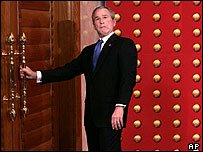
I really am surprised that no one has thought of making a new Odd Couple show out of the adventures of Hugo and Dubya.
Monday, November 21, 2005
Singing Chavez
If anyone knows of a way to get a recording of Hugo Chavez singing "El Rey," let me know. Its entertainment value is through the roof and I'd be forever thankful.

Sunday, November 20, 2005
We went to dinner at a local Denny's-type place--you know, mashed potatoes and pie--, and had a waitress who kept forgetting parts of our order. She apologized profusely and told us it was her first day. She had an accent--my first guess was Ukraine or Russia and was, other than the forgetting, perfectly nice.
Towards the end of the meal, a new party was seated near us. Most of them were wearing purple UW sweatshirts (it was Apple Cup weekend), and one man at the table started a conversation with the waitress in a fatherly tone. He asked her where her last name originated (Poland/Lithuania), and later, what brought her to the US.
"Well, you know Chernobyl," she started. "We lived near there, and after that happened, my sistered developed leukemia, so my mother and grandmother started trying to apply to all different places to go to, and this is the first one that said yes."
Nervous laughter.
"Oh," someone choked out. "That's nice."
Friday, November 18, 2005
Thunk.
Well, I used to have a website with a journal of sorts, but as of late I found I didn't feel comfortable posting there, because it was too easy to find by anyone from work who might Google me, or by people I'd met IRL I didn't really care for, etc. So I landed here; livejournal has a little too much of a teenage "I'm fat!" "No you're not! I'm fat!" "No you're not! I am!" vibe, and this has an easy way of managing posts.
I may move some of my older entries that I'm fond of from my other journal here later on, but for now this is enough to get me started.
Sunday, January 16, 2005
She's dead. My sister called and left a message saying she had something important to say. I wouldn't really have wanted her to just leave a message about it. I called my family. It rang busy. I left a crying, slobbering message. No one called back. A couple of days later, I saw an announcement sent by email by my dad. "Announcement"--worded formally and meant for friends and acquaintances. I don't check my email very often anymore because of all the spam. I spoke to my sister again later that night and she gave me a little more detail. She suggested I call my mom again, since sometimes their phone rings busy when it's not and it's not very reliable about messages. I called my mom again and was able to speak to her. She had tried calling my cellphone. I wasn't angry about it then, but now, thinking back, I feel furious. It was her mother, so I didn't expect her to be making phone calls, etc. But it's not as if she's the only person in the family. Yes, I realize it's selfish and I do feel low and petty and bad about it. But goddammit. I haven't had that cell phone for two years. How many times have I given them my number, how many guilt-trips over 'please give us a way to contact you,' how many times have I explained that my home number is the only number I have anymore? And for what? Whenever something important happens, everyone gets confused or forgets or fuck if I know what and no one calls. My sister is the only one with enough presence of mind to actually write down my number. My dad couldn't even bother to send me a quick separate note by email.
Wednesday, January 12, 2005
Escarcha.
I'm terrible about keeping in touch. Sabotaging my own relationships plays no small part in this, but even when I'm not in a particularly self-destructive mood, I'm simply, well, just bad at it.
Once in a while, my parents send me a greeting card by email. I'm always touched. A lot of times I don't know what to reply with. If I'm in one of my more isolation-prone moods, I procrastinate the reply until it's forgotten.
My dad starts calling me. I don't want to talk to him. My dad is a good man. I don't want to talk to him. I don't want to talk to anyone. I let the machine get it--half the time he calls when I'm not there anyway, and I don't check my messages because I don't want to talk to people.
His messages go from "Just calling to see how you're doing," to "please email me, I would like to know how things are going." He sounds profoundly sad. I feel bad. Part of the problem--besides my messed up thinking--is that my dad and I have fundamentally different ideas about communication. I don't see the need for a lot of ooohs and ahs in conversation, or in email, replying just to say "ok" or "=)" or whatever.
He keeps calling. I don't know what to say to him. I don't want to talk to him, anyway. I don't even have long distance to call him back. I don't understand what he wants from me--I mean, I "know" he wants to just talk, but I don't really understand, not at a gut level, what he wants, why he wants to talk to me. The more he calls, the less I want to email back, not to mention speak to him.
I finally send him a short email saying that I'm ok, I'm working at soandso, and that I don't really know what else to say because I don't really want to speak to anyone. He replies with a long email talking about how my grandmother is increasingly old and frail and we should be ready for her to die at any moment. Over and over. And what's my phone number where he can reach me so he can call me when it happens.
I want to punch the screen. I know my grandmother is 91 and her health isn't good anymore. Why is he doing this to me? Why does he think it's of any use, of any help, to go on and on about this? What's he expecting me to do about it? What does he think beating it into my head will do? Does he think I don't care? And what the hell does mean by couldIpleasegivehimaphonenumbertocall? He's been calling my home number, which is the only one I have. Where does he think he's been calling? Is that even supposed to mean something, or is it his way of making small talk?
I let his message sit, unanswered, in my inbox.
My sister calls one morning for help with some school stuff. I'm just getting home after having worked an 11-hour, all-night shift. I help her as best I can, tell her about my schedule, then go to bed.
A few hours later, I'm woken up by the phone ringing downstairs. I don't keep a phone in the bedroom. The machine picks up, and I hear my sister telling me to wake up. She is loud, always so loud, and just keeps saying "wake up, wake uuuup!" in a half-cheeful voice. Her annoyance is palpable. I curse under my breath. She used to do this when we were living at home, too--I'd be trying to take a nap on the couch, and she thought it was hilarious to come up behind me and scream "WAKE UP!" What the fuck is wrong with people, why will no one just leave a fucking message on the fucking answering machine, why must they go on and on asking that someone pick up? Don't you think if I was there, or if I wanted to talk to you, I would have picked up by now? I clutch my giant stuffed animal and stare daggers at the ceiling.
She finally exhausts her "wake up" repertoire, and starts leaving a message. My grandmother is very ill. They've taken her to the hospital in an ambulance. I feel the blood drain out of me. I am briefly angry that it takes her so long to get to this part of the message, that it would be just like her to just call and whine at me to wake up from the few hours' sleep I can get before going back to work for another 10-hour shift, just to ask some stupid question--like what time zone my parents are at. Not that the question itself is stupid, but it's not important enough to demand rushing to the phone from bed and answering it RIGHT NOW. In that flash of anger, I hate her because she does stuff like this and I couldn't tell from the start of the message--"wake up, I need to talk to youuuuuu," etc.--that it was actually something important.
One of the reasons I really wanted to kill myself before turning 21 was that I couldn't bear the thought of my grandmother dying. I wanted to be dead before she was.
I. Feel. Nothing.
I listen to the rest of her message from bed. Even though I'm awake, I just stay in bed and try to go back to sleep. I feel nothing. I can't fall back asleep though, so I get up, go downstairs, and play on the computer. When Jed gets home, I don't even tell him right away. I am a sociopath. I am selfish. I don't even feel numb. I just don't feel.
I am buckling, and I try to hold on to that, to not feeling anything. Once in a while though, I crack, I start sobbing, but then bounce back to the bliss of feeling nothing. I can't look at Jed in the eye.
Later, from work, I call my dad to see what's going on. I hate myself for not calling sooner. I can't give him any comfort. I give him my work number, like throwing half-rotten table scraps at a dog. It has to be a brief conversation because otherwise I will start sobbing in the office, and my coworker is still there.
I talk to Ben about things going on in his life through IM at work. I can't give him anything either.
I can't give anyone what they want from me, or what they might need from me. I am empty. I feel nothing. I am selfish and most of all, weak.
Friday, October 08, 2004
A letter to my boss.
Originally posted to QCDN.
Dear Boss,
Please make an effort to lock the bathroom door when you're using it.
Regards,
Anesly.
MY EYES!!!
Goddammit, I knew I should've stayed home today.
Thursday, September 02, 2004
What the hell is going on with escalation of violence in Russia? In just a few days, two airplanes downed, suicide bombing in a subway, and now this siege at a school. I guess the Chechen fighters decided the world wasn't paying enough attention to them.
And I suppose they are at least somewhat right about that--the world at large seems to care not a whit about the reported human rights abuses and ongoing war in Chechnya. Sure, it gets a blip on the BBC or NPR radars, but you don't really hear about it in the more popular outlets. They are too busy covering the mindnumbing, selfcongratulatory schmoozefests that are the Democrat and Republican Conventions. Putin proclaims normalization, lumps the Chechens in with the war on terror, and the international community seems all too eager to let Chechnya be the proverbial elephant in the room (and it's getting crowded in there).
Though Putin rushed to join the "war on terror" bandwagon and put the pro-independence Chechen thorn in his side in the terrorist category, he has turned down the feeble calls for a greater role for the UN in the area. There's been fighting in Chechnya for the last ten years.
Separatist or pro-independence groups are a sticky issue. On the one hand, in theory, it'd be nice if no group of people had to stay part of a country they don't want to be in. But it's not really practical--the world's existing countries have an interest in preserving the status quo and in not encouraging this sort of thing lest it happen to them. And I think if this were the case (that is, if chunks of any country could leave their parent country at any time), it'd be much too easy to quickly descend into chaos--a worldwide Balkanization. I suppose after some time, small nation states would start grouping together to form larger ones, until people started getting sick of it again, and dissolve into small groups again. I can only imagine what kind of havoc this cycle would wreak on world economy--trade, transportation, infrastructure, etc.
The existing nations of the world, of course, also have an interest in not letting countries invade each other--because (among many other reasons) of the precedent it sets for them.
I think it's easy to see where these two interests might come into conflict. What's the magic number to mark a country as being invaded recently enough to warrant help in ousting the invaders, at what point have the invaders been there long enough to consider the affair done with? What about conflicts that have the support of the majority of the native population and have been ongoing for a very long time? I don't have the answers.
At any rate, I was able to gather the following bits of history on Chechnya, mostly from the BBC (which I love dearly). Chechnya was first conquered by Russia in 1858. My own native Chile was only about 40 years old then, the war for independence from Spanish rule having only started in 1810. Similar pro-independence movements were going on throughout South America. In 1922, Chechnya was declared an autonomous region (and a Soviet Socialist Republic in 1934); in 1944, Stalin deported the entire Chechen and Ingush populations. Sixty years is not enough to forget that kind of sociopathic madness.
By 1991, with the collapse of the USSR, the local Communist leader was overthrown, and Chechnya was declared independent from Russia, and a year later, adopted a constitution that defined it as a secular state governed by a president and parliament. The Russians, none too happy with this, came in 1994. According to the BBC, up to 100,000 people were killed over the next 20 months. One. Hundred. Thousand. That's 5,000 a month. That's September 11 and then some every month.
It's hard for me to relate to carnage of such proportions; I know the numbers are large, but the casualties and the effect on individuals remain abstracts, blank cutouts in a shooting range. Maybe that's part of why the world doesn't do anything. The advances in technology haven't changed the fact that places like Chechnya are very far away--even though you may be able to get there in just a few days, you don't get to see what's going on there in a meaningful, everyday way any more than you did a hundred years ago. Sure, there's TV, but the images of TV resemble an action movie more than anything real--sanitized and dreamlike.
In 2000, Russia appointed Akhmat Kadyrov as the head of its administration in Chechnya. In 2003, Kadyrov was elected president in an election that was at least suspicious and troubled. Less than a year later, this May, he was killed in a bomb blast. In August, Kremlin-backed Alu Alkhanov was elected as president, though critics claim that, again, these elections were not free or fair.
But though I think there is plenty of blame to lay at Putin and Russia's feet, the Chechen fighters have been making things worse. The strategy of hostage-taking goes back to as far as 1995, when hundreds were taken at a hospital. I admit that my sympathies tend to go towards the people fighting for independence instead of the rulers in this type of thing, but spreading the conflict to civilians, resorting to hostages and suicide bombings of people who aren't directly involved in the conflict are simply not acceptable in my mind--that's where you cross the line and become simply a terrorist.
Russia captured Grozny in 2000, after attacks by Chechens (including a series of apartment block bombings that killed some 300 people). Some 200,000 civilians fled Chechnya.
And of course, there was the theater siege in 2002; sure, Russian response wasn't good by any stretch of the imagination--more people died when the soldiers stormed the place than at the hands of the Chechens, but goddammit, you can't just go in to a theater full of people and take them hostage and expect anything good to come out of it.
Which brings me to today. Whose bright idea was it to take a school hostage? I have to assume that the people who did this don't care about sliding from freedom fighters into terrorists; that they think hostage-taking is a valid way to get things done; that they don't care about involving the civilian population. OK. Not fine, but OK. Even taking that into account, didn't it occur to anyone planning this thing, that, if nothing else, it's really bad PR for your cause? It's a bunch of schoolchildren, parents, and teachers, for crying out loud. Just add some grandmothers and puppies, and you're set. It's not even like they had the excuse of saying they were acting suspicious, or allied with the Russian government, or causing trouble. These are just people starting their schoolyear.
Even discounting the adults, no one likes to see children harmed. And surely this played an important part in deciding to take them hostage--they must have figured that it would put the Russian government in an untennable position, that the families and community--the world--would be pushing for the hostages to go unharmed. And that's true. But on the other hand, people are probably also cheering that these terrorists rot in jail for the rest of their lives, and any shred of sympathy for them is gone. From a purely strategic point of view, it seems idiotic and shortsighted; the more gruesome the actions by a group like this, the more strongly the government will react, the more that common people will turn against it, the more the international community will clamor for harsh actions to be taken against them. The long-term harm an action like this would bring to any movement seems to me to far outweigh whatever demands might be met because of the shock of who the hostages are.
I find myself so tired and frustrated with the world news. I do hope those bastards get to spend their lives in jail, but they'll more likely end up dead. Which I guess is OK. Like everyone else, I hope the hostages come out of this fine, but honestly, I'm not optimistic.
Monday, August 30, 2004
Pop Vultures: Public Radio for Dummies
I am a total NPR junkie. I actually don't mind pledge week. I can recite the weekly lineup off the top of my head. I get annoyed when programming changes suddenly or a host is replaced (yes, I'm still cranky about Bob Edwards). I am, in short, a big nerdy NPR addict.
Our local station, KUOW, has one of the largest audiences in the country, so we sometimes get to listen to pilots of new shows before they are established and go national. One of them, Pop Vultures, had a nice enough premise: a group of friends who discuss pop music. The people sound fairly young, and they aren't professional critics. They're just people who really like pop music. I had hope for this show.
Unfortunately, the show collapses under the weight of its own meaningless drivel and self-indulgence. The host, Kate Sullivan, is in her thirties, but sounds much younger--partly because she seems unable to string together a coherent idea without using "like" or "you know" every fifth word or so, her speech is full of awkward pauses, and she ends every sentence with an upward lilt of her voice that's usually reserved for questions. In short, she sounds like the worst kind of insecure, giggling teenager.
The format is conversations between Kate and the rest of the Vultures, her friends. I can understand the awkward pauses in this format--they're going for a natural feel (though awkward pauses on NPR are too often used by writers and commentators to telegraph "I am saying something very important and emotionally touching right now"), so I can understand the decision to leave those in. But I can't help but think that any grown woman should be able to come up with something better than, "Four is like, an organic number. [...] You have four Beatles." To add to this, her delivery is stilted, punctuated by random giggling, and a lot of "Umm..." and "Uh..." (in addition to my above complaint of the constant use of "like" and "you know").
Ironically enough, Sullivan stumbles onto what I think is one of the major problems of the show on the first installment: "Coolness," she says, "is in the eye of the beholder." It's tough to critique music in a meaningful way--it's almost entirely a matter of taste. The show doesn't bother to acknowledge this at all; the Vultures' opinions are presented as fact, and anyone who disagrees is either a snob, ignorant, or just plain stupid. I don't expect reviews or critiques to agree with me, but I think it would be much more effective if the Vultures' actually bothered to explain why a particular band matters to them, why they think it has some historical importance to pop music as a whole, and what it is about a particular singer or song that touches them and stirs them. For example, on the first show, Sullivan talks about The White Stripes. She is a big fan, and at the start of this section of the show, she says, "When I talk about The White Stripes, I get really dumb. Because I love them, truly. And, I think that when you love a band, like deeply, you get really really stupid." This is actually a good start--who can't relate to the giddy, exhilarating feeling of passion for a singer/band, that feeling that takes your dignity and leaves you a drooling fangirl/boy? She goes on to talk about The White Stripes with another one of the Vultures, who says that they remind him of "really bad music. [...] It's like, somebody forgot to get a bass player, there's, you know--someone forgot to buy new cymbals." This is actually a nice change--for the remaining episodes, the other Vultures are mostly relegated to the role of yes-men. Sullivan's response to her friend's opinion of her beloved band though, is more typical of the tone of the show: "Who cares if they can't play. What-ever. But even if they couldn't, do I give a shit?"
The program does occasionally show some flash of insight. Some of its best moments come in conversations between the guys (Sullivan's conversations with her friend Hillary tend to degenerate into giggling and just agreeing with each other over and over). They will actually occasionally explain why they like something, or, even better, explain the context that a certain song came into being in, and explain why they think it's important to music as a whole. These moments are few and far between, and the conversations between the men feature a lot of Beavis-and-Butthead-style laughing and drooling over female performers' "hotness".
In between these glimmers of insight, we are subjected to statments like "The teen pop phenomenon, I think, started with the Spice Girls. I would contend that the Spice Girls were the big bang of teen pop." Because there were no teen idols before the Spice Girls, right. Or, when calling her friend to talk about the "Britney-Christina debate": "Everything Britney touches turns to fairy dust." "And everything Christina touches," her friend adds, "is just...normal."
In fact, some of the lowest points of the show come in conversations between Kate and her friend Hillary. In show three, they go on at length about Weezer's Say It Ain't So. Sullivan actually seems to have a good grasp of what the song is about (alcoholism and repeating the destructive patterns of, in this case, a father). But then, there's this:
"And like, when you see them live, that's, I mean, I think that's their most popular song, like, that's certainly the one where all the kids are singing along impassioned and, punching their fists in the air, with like, the passion of someone who lived through it, and that's when you really go like, 'alcoholism is the epidemic."
Call me cynical, but I'd be willing to bet that most kids at a Weezer concert are just pumping their fists in the air to a really rocking song.
Sometimes, Kate and Hillary's conversations descend into the downright catty. Also in show three, they spend almost half the show bashing Sheryl Crow. I am personally not a big Sheryl Crow fan, especially not recent songs (I do like The Globe Sessions, though), but the tone of this conversation is beyond petty. They offer no reason as to why they do this. I can only guess that Crow has failed to meet some unstated standard of coolness.
"Hillary, I don't wanna drag you down, or tie you down, but I want you to talk a little bit right now about Sheryl Crow."
"Puh-leeease. She's like, the richest person in the world, sitting in the front row of Versace shows, and singing about how she's so poor..."
"Nooo!" gasps Kate.
"There's a line that says, 'I don't have diddly squat,' I think."
Hillary continues, to more astounded gasps from Kate. "It's true. It's in the song."
"Aww, nuts," gasps Kate.
"She's singing like, 'I can't afford anything but everything's gonna be ok.' Uh..."
"Oh, it's so brave of her!" Kate adds in a condescending tone.
Apparently the idea of a song not being a biographical documentary has never occurred to them.
Sullivan starts trying to explain what her problem with Crow is, and it degenerates into an extended rant:
"It's that, like, you know, there are so few women in rock music, in rock and roll, pop, whatever you wanna call it, so few, and there's so many vacuous, just, idiots, women in pop, that like, if a woman actually, like, gets to a certain level of notoriety within rock, you, you kind of, hope that she's gonna kick some ass, that she's gonna, she's gonna stand for something, she's gonna mix it up a little bit. You know, like maybe even like Madonna, like just, just mix it up and freak people out and get controversial, just cause it's fun, for no other reason, you know, she's [Crow] done nothing like that, and she even had like, potential, like, she seemed like she was kind of a liberal, you know, sort of, pro-choice, and sort of, vaguely hippie-esque, and now she's just like, really rich, and gross, and she never does anything controversial, you know, her big political statement is like, having dinner with Bill Clinton. Hel-lo?"
I guess everything Sheryl touches does not turn to fairy dust.
Kate and Hillary laugh, and continue on:
"I feel the same way about Liz Phair," adds Hillary.
"Oh, totally! Total rich housewife. Rich Chicago housewife."
(Are rich Chicago housewives more evil than regular non-Chicago housewives?)
"Yeah!"
"The first time I saw her," Hillary adds, "she was so scared to go on stage that she was throwing up before, and like, was absolutely terrified to be on stage. And then you and I went to see her at the University, and she was kind of doing that, she was like, tan, remember, she was tan?"
"She was really tan, and that was really disturbing," agrees Kate.
"I know, she's tanned, and she had like, some flowy pants on her, or something, didn't she? And like, nice tennis shoes, and she looked like a housewife, and then she was kind of doing that awful skippy dance across the stage, and she had all these backup singers, and stuff, that were like, beaming at her."
Tans and flowy pants, the unmistakable signs of bad music.
"And the show was really really short, cause she just got..."
"And boring," interrupts Hillary.
"...tired, or didn't feel like it," continues Kate, "and it was boring as hell, and you just really got the feeling that, underneath it all her goal had been just to be pretty, and rich, and well-known..."
"And well-liked."
"And well-liked, exactly." Agrees Kate. "And when she had achieved that, then it was time to have a baby. And um, and Sheryl Crow, I kind of feel like the same thing, like now that she's you know, famous, and pretty, and she gets to wear Versace, and go to Versace shows, and eat Versaces, and..." (Versace pronounced "Versa-ce" each time.)
"And she can wear really high-heeled shoes because she doesn't have to walk anywhere anymore," adds Hillary (though a couple of shows later she praises Mary J. Blige for being able to hop around the stage in really high heels).
"Right, and she can talk about how, how bad it is that teen pop queens get, get half naked in magazines, and the she can pose on the cover of "Stuff" magazine, in shorts going up her butt."
"Yeah, it's fine..."
"It's fine..."
"Whatever..."
"Yeah, it's all good..."
"That's not even good controversy," concludes Hillary.
"We hate her, let's not talk about her."
I could only wish they had decided that before spending half the show on this.
"She's not interesting."
"No, she's boring."
And so is this conversation. And that may be its biggest fault; I like snark as much as the next jaded bastard (see TWOP for some great, witty snark). I can appreciate a good rant. But this is just self-indulgent rambling--which is fine to do with your friends, but it's not worth building a Public Radio show around.
The rest of this particular show is spent bashing Sting, whose sin is, apparently, that he's "so completely unaware of his own complete whackness."
On another occasion, Kate talks to Hillary about her experience watching Snoop Dogg. They get right down to the important musical issues: Kate wants to know what he was wearing. After they sort that out, the rest of the conversation revolves around how hostile Dogg was towards the audience, and how, according to Hillary, that was "just so hot" and "sexy." It made my head hurt.
To close, I'll just leave you with some choice quotes from Sullivan:
"One of the things I liked about ["American Idol"] was like, I felt that, in a sad way, it united America." (maybe Bush should use that as a campaign slogan: "Uniting people through, like, you know, 'American Idol,' and stuff.")
"Anybody who actually says the Backstreet Boys are bad, either they're not listening or don't know good music."
About current teen fashion: "I don't know how it happened, I mean, I suppose it's the eighties revival, whatever, but it's one of those revivals that is so completely not annoying." Almost the entirety of show twelve is built around how the eighties revival is, after all, pretty annoying.
"I mean, I guess what I, I guess what I like about Pink most of all is that, uh, I don't know, like she smokes a lot. I like that about her, like, she smokes menthols, and to me, that's like, keeping it real."
"Well, Outkast make me feel like I fit in this world, like I have a place in this world. And maybe I have a place in other worlds too. Um, Outkast make me proud to be an American. Outkast make me proud to be a black man."
Rock on, brother Sullivan.
Tuesday, August 24, 2004
Rigor
One day when I was 20, I woke up achy all over. I thought I'd slept funny--I had kind of an uncomfortable bed at the time--, and didn't give it much attention. The next day, the pain was still there, but again, it happens, some times muscle pain lasts a few days. This didn't quite feel like any muscle pain I'd had before, but I couldn't think of anything else it might be, and it was mild enough to not seem to warrant any additional attention.
The pain never went away, and it got worse as time went by. My joints would swell up in the morning--my fingers and toes felt like sausages. I started walking slower. I was having trouble getting to the second floor at school and having to take the elevator. I had piano class first thing in the morning, and it was torture. I still didn't go to the doctor, not sure why. I'm sure the fact that I was really depressed played some part, but I wonder if I didn't think that I was just lazy or something. Who knows. About a year later, I finally mentioned it to my doctor, who referred me to a rheumatologist, who ran a bunch of tests on me, and declared it rheumatoid arthritis.
Rheumatoid arthritis is a fun condition where, basically, for reasons unkown, your immune system decides to start attacking your joints. This was kind of baffling to me; all I really knew about arthritis was that it was a disease affecting the joints, and that it affected older people (and getting enough calcium, etc., throughout your life helped so you would be less likely to suffer from it). That's of course an entirely different type of arthritis, but I think this is what most people think of when someone mentions arthritis. It now seems a bit odd to me, but I accepted the diagnosis without any denial or anger or anything. Might have been the depression--when I'm really depressed, I have three moods: numb, sad, and suicidal--, might have been just the way I am--my general attitude towards life could be summed up as "kind of amused." My parents, however, were an entirely different story. How could their 21 year-old daughter have an old person's disease? How was it that, living in the US, people didn't know what caused it? Surely there must be some cure, this is not some third-world country. My own feelings at the time were just a mildly curious "huh, arthritis, chronic disease. Huh."
I didn't go back for treatment though. I don't remember why, probably put it off as part of my strict regimen of Not Doing Things Because of Depression. I didn't realize at the time that I was depressed--not in the clinical sense, anyway--and this was the year that it all came to a head. But that's another entry--for now, all that matters is that depression had seeped into every part of my life, paralyzing and stripping me of even the most basic of impulses. The RA got worse. I dropped out of school, and had no insurance. I didn't see a doctor for over another year.
I got married just before turning 22, and then got insurance coverage through my husband. By this time, doing anything was a very painful ordeal. Walking was this odd slow-motion activity with tiny tiny steps. Getting in the car meant walking my pathetic walk to the door; opening the door; aiming my back towards the seat; throwing myself in, stifling a scream of pain, and dragging my feet inside.
I found a great rheumatologist. She put me on antiinflammatories (steroids) right away, and it was an incredible rush. But of course you can't--or rather, you shouldn't--stay on on those for very long. You have to find some medication to actually control the disease and maybe reverse or stop the damage. We tried medication after medication. Nothing worked. And arthritis medications have nasty side effects--because it's an autoimmune disease, the medications weaken your immune system, which means you're more prone to catch all kinds of other things. At one point, I was taking an arthritis medication, something else to prevent possibly getting tuberculosis, and then something else to counteract a peripheral neuropathy (damage to the nerves on my legs, in this case) caused by the TB medications.
We finally found something that worked. It involved going to the hospital once a month and getting an IV infusion, and it was amazing. It was almost like I didn't have this insidious disease at all. And then, of course, I started having an allergic reaction to it, and had to stop. It almost seems like a dream now.
We tried a bunch more things, nothing worked. In November of last year, I caught a cold that lasted through the start of the year, and went into my nastiest bout with depression since being diagnosed at 21. My arthritis flared up to the point that often I couldn't get out of bed and had to miss work. I also developed fibromyalgia--my body's threshold for pain plummeted and my muscles went to hell from lack of use, meaning I was in constant pain not only in my joints, but also on every bit of flesh in between joints. I'd fall asleep through the day, because at night I'd wake up every two or three minutes because of the pain.
There was basically one more medication to try out, and then we'd, as silly as it sounds, just run out. This one involved injecting myself once every two weeks. It seemed to do nothing. I was feeling desperate at last. My doctor decided to add another medication that I had tried before, but that I'd had nasty side effects from, and luckily I tolerated it fine this time. It was very slow going though--it took a long time before I actually started feeling a difference. Not feeling "normal" by a long shot, mind you, but only mildly stiff and swollen on my best days, and able to move around, for the most part.
I have been on prednisone (the antiinflammatory) for about three years now, on relatively high doses. This has done all kinds of nasty things to my body. Even on good days, I'm usually not able to bend down, or do simple things like put on my own shoes and socks. On medium days, I can't stand for any length of time or take a shower. On bad days, I can't stand at all, can't get out of bed, and am confined to laying there and listening to the radio, because I can't even hold a book to read.
I often feel like I have no meaningful frame of reference. When my doctor asks me how I'm doing, I stare blankly and try to figure it out. Luckily she understands. I've lost all sense of what being a healthy person feels like.
My Saturdays start now with 12 pills of various arthritis medications and a shot (not to mention the myriad daily pills for depression, etc.).
But I'm at work.
On good days, I can chase my dog (walking fast) halfway across the living room.
Wednesday, July 28, 2004
just so you know...
I'm still around. I have been busy being sick, etc. I'm feeling a little better. I don't really answer personal email because I don't want to talk to people. But I'm still around.
Wednesday, December 31, 2003
Phenomenal Woman
Here's a nice poem by Maya Angelou to end the year on an upbeat note. This was given to me by Erna, a coworker who does stuff with Women in Black.
Phenomenal Woman
Pretty women wonder where my secret lies.
I'm not cute or built to suit a fashion model's size
But when I start to tell them,
They think I'm telling lies.
I say,
It's in the reach of my arms,
The span of my hips,
The stride of my step,
The curl of my lips.
I'm a woman
Phenomenally.
Phenomenal woman,
That's me.
I walk into a room
Just as cool as you please,
And to a man,
The fellows stand or
Fall down on their knees.
Then they swarm around me,
A hive of honey bees.
I say,
It's the fire in my eyes,
And the flash of my teeth,
The swing in my waist,
And the joy in my feet.
I'm a woman
Phenomenally. Phenomenal woman,
That's me.
Men themselves have wondered
What they see in me.
They try so much
But they can't touch
My inner mystery.
When I try to sho them,
They say they still can't see.
I say,
It's in the arch of my back,
The sun of my smile,
The ride of my breasts,
The grace of my style.
I'm a woman
Phenomenally.
Phenomenal woman,
That's me.
Now you understand
Just why my head's not bowed.
I don't shout or jump about
Or have to talk real loud.
When you see me passing,
It ought to make you proud.
I say,
It's in the click of my heels,
The bend of my hair,
the palm of my hand,
The need for my care. 'Cause I'm a woman
Phenomenally.
Phenomenal woman,
That's me.
Thursday, September 11, 2003
An excuse

Father, it's been thirty years since my last confession.
Both El Mercurio and the BBC have the story and pictures of what happened thirty years ago in Chile, free to anyone who seeks to know. Thirty years ago, Augusto Pinochet (may he die in fear), led a coup that ended--started?--with the death of the democratically elected President of the country, Salvador Allende ("the President of Chile does not flee in a plane," he said when offered safe passage) and then, seventeen years of dictatorship. Seventeen years and thousands vanished, murdered by Pinochet and his ilk who turned "to disappear" into something done to your enemies. Thousands "disappearead" and yet more live on to demand some sort of justice, though probably in vain. Well-mannered people, you see, do not speak of maimings and rapes and electrodes and beatings and bludgeonings with lengths of metal chains.
So thirty years ago, Pinochet and friends burned the Presidential Palace and set tanks out to mingle with the few who dared step outside. People were detained, lined up, laid on the floor like leaves in autumn, herded into the Estadio Nacional, which was turned into a center of torture and murder. Books and posters were dragged out into the streets and set on fire. There was martial law and curfews.
My parents--people who have never publicly been involved in politics, and who lean more to the right than the left--my parents lowered their voices whenever September 11 or Allende or the DINA (the Chilean intelligence agency responsible for what was, until September 11 2001, the deadliest terrorist attack on US soil) for years after this happened. Whispering and not talking of these unpleasant things has seeped into the blood of much of the people of Chile. My mother, not long ago, told me that perhaps I shouldn't rant against the US government in public, or on the web. The unspoken consequences left a chill in my spine for days.
So we come to September 11, 2001. More death and fire and firefighters carrying whatever bodies they could find. More people detained with no recourse. More ominous warnings to "watch what [you] say." And then, this: the hijacking of those events to clear the way for war and profits. War on places that had nothing to do with it. Questions of whether the Bush administration could have stopped the attacks from happening silenced. Anyone who doesn't fall in line with this "patriotism" considered almost a terrorist. September 11, 1973 was used in Chile as an excuse for seventeen years to silence its people under a traitor that ruled and destroyed ruthlessly. September 11, 2001, is, I fear, being used in the same way by Bush & Co.
In El Mercurio's site, I found this picture taken on September 11,
1973. The caption read simply, "workers surrender."

Subscribe to:
Posts (Atom)
